
Working Papers
Large Language Model Hacking: Quantifying the Hidden Risks of Using LLMs for Text Annotation
Pre-print available at arXiv
With Joahim Baumann, Paul Röttger , Aleksandra Urman, Flor Miriam Plaza-del-Arco, Johannes B. Gruber, and Dirk Hovy
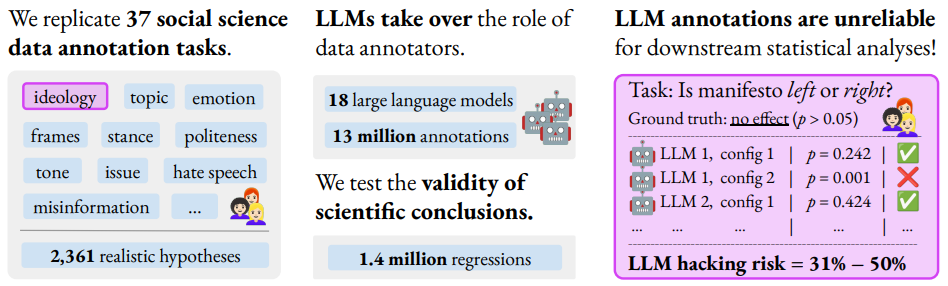
We quantify the risk of LLM hacking by replicating 37 data annotation tasks from 21 published social science research studies with 18 different models. Analyzing 13 million LLM labels, we test 2,361 realistic hypotheses to measure how plausible researcher choices affect statistical conclusions. We find incorrect conclusions based on LLM-annotated data in approximately one in three hypotheses for state-of-the-art (SOTA) models, and in half the hypotheses for small language models. While our findings show that higher task performance and better general model capabilities reduce LLM hacking risk, even highly accurate models do not completely eliminate it. The risk of LLM hacking decreases as effect sizes increase, indicating the need for more rigorous verification of findings near significance thresholds. Our extensive analysis of LLM hacking mitigation techniques emphasizes the importance of human annotations in reducing false positive findings and improving model selection. Surprisingly, common regression estimator correction techniques are largely ineffective in reducing LLM hacking risk, as they heavily trade off Type I vs. Type II errors.
Beyond accidental errors, we find that intentional LLM hacking is unacceptably simple. With few LLMs and just a handful of prompt paraphrases, anything can be presented as statistically significant. Overall, our findings advocate for a fundamental shift in LLM-assisted research practices, from viewing LLMs as convenient black-box annotators to seeing them as complex instruments that require rigorous validation. Based on our findings, we publish a list of practical recommendations to limit accidental and deliberate LLM hacking for various common tasks.
The Machinery of Rule: The Rise of Royal Administrative Orders in Medieval England
With Anders Wieland, Andrej Kokkonen, Jørgen Møller
Seminal theories of European state-building identify administrative capacity as central to the rise of the modern state and emphasize England as a forerunner, with downstream consequences for European state formation. Yet the timing and development of this administrative dimension of state-building remain largely unexplored due to lack of data. This paper fills this gap by constructing a novel database of administrative capacity in medieval England (1216–1399). We collect data from the Chancery Rolls, a remarkably detailed archive of administrative records. Our database encompasses nearly 300,000 royal administrative orders issued by the Crown. We trace the evolution of royal orders: their rise to prominence and diffusion across the kingdom, increasingly bureaucratic language, deployment as royal patronage, and use as directives to local officials. Our findings speak to debates on the historical origins of the European state, indicating that administrative capacity has medieval roots rather than being primarily an early modern development.